

DTB crystallizer
The core feature of the DTB crystallizer (deflector - baffle crystallizer) is the built-in deflector and baffle, which enables the crystallization cycle and clarification separation, and has the advantages of high crystallization efficiency, flexible operation, and controllable crystal particle size. It is widely used in the chemical, food, pharmaceutical and other industries. The following table is broken down by core technology category to compare the detailed technical information of DTB crystallizers in vacuum and cooling forms.
How it works
Crystallization technology form | How it works |
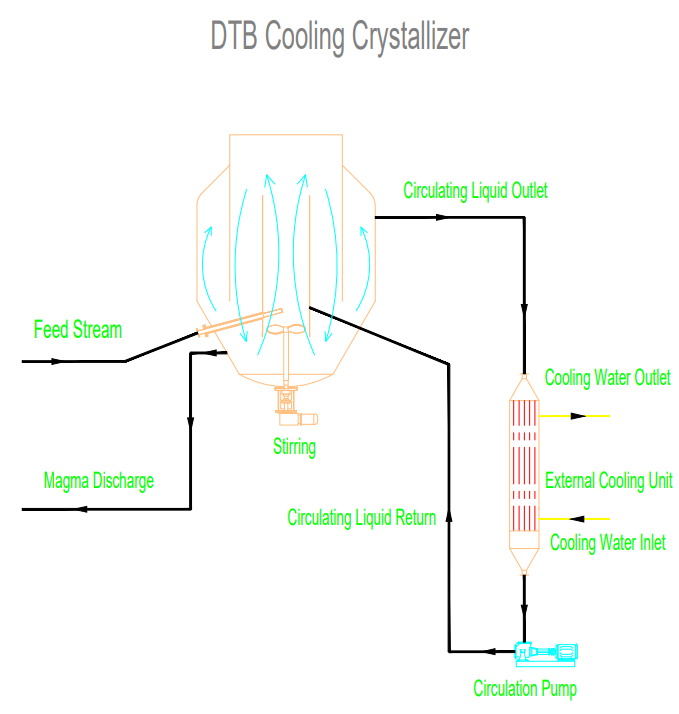
DTB- Cooled crystalline | Transfer heat through an external heat exchanger or an internal cooling coil to lower the material temperature to form supersaturation; With the help of the agitator inside the deflector to drive the material circulation, crystals are suspended and grow in the crystallization zone, and baffles separate the clarification zone from the crystallization zone to prevent fine crystals from being lost with the mother liquor, achieving crystal grading and continuous growth. |
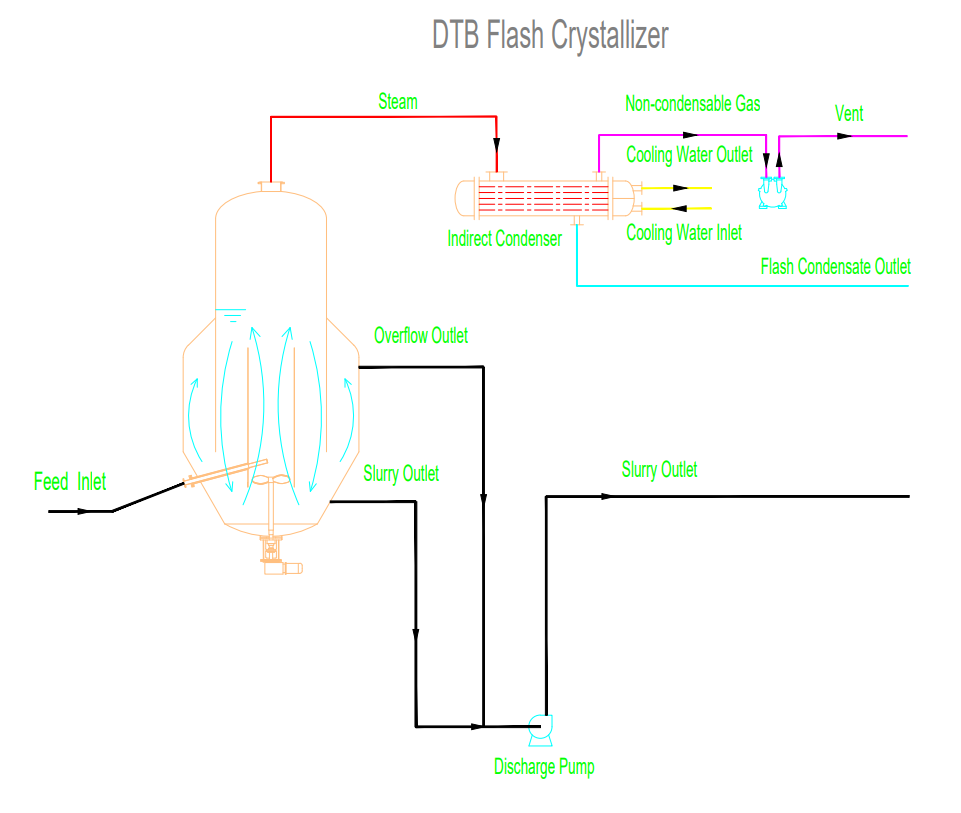
DTB- Vacuum crystalline (evaporative) | Vacuum flash cooling is used. A vacuum pump is used to maintain negative pressure inside the crystallizer, which lowers the boiling point of the material and causes flash evaporation, releasing latent heat for cooling, thereby forming supersaturation to promote crystal precipitation; The built-in deflector and agitator drive the material to circulate efficiently, the baffle separates the clarification zone from the crystallization zone to reduce the entrainment of fine crystals and ensure the stability of crystal growth, and the condenser recovers the flash steam for continuous operation. |
Key technical indicators
Crystallization technology form | Key technical indicators |
DTB- Cooled crystalline type | 1. Crystal size: 0.1-5mm (adjusted according to material properties and process); 2. Particle size distribution: RSD≤20%; In the case of potassium nitrate, the proportion of products with a crystal size of 0.5 mm -1.5 mm is over 85%, which is much higher than the 50% or less of traditional batch crystallization products. 3. Operation mode: Continuous/intermittent is acceptable, with PLC variable frequency control of stirring speed; 4. Core structure: Built-in deflector, baffle, agitator, with external heat exchanger or built-in cooling coil. |
DTB- Vacuum crystallization (evaporative) | 1. Crystal size: 0.1-5mm (adjusted according to material properties and process); 2. Particle size distribution: RSD≤20%; 3. Operating mode: Continuous/intermittent is acceptable, mostly continuous operation, vacuum degree 0.06-0.095MPa (adjustable); 4. Core structure: Built-in deflector, baffle, agitator, vacuum pump, condenser, flash chamber. |
Material selection comparison table
Crystallization technique form | Material selection |
DTB- Cooled crystalline type | 1. Base material: SUS304 stainless steel (non-corrosive/weakly corrosive, normal-temperature and normal-pressure, common inorganic salt scenarios); 2 Corrosion-resistant material: SUS316L stainless steel (moderately corrosive, containing a small amount of acid/alkali/chloride ions, fine chemical scenarios); 3. High corrosion-resistant materials: Titanium alloy, Hastelloy (strong corrosiveness, high temperature and high pressure, harsh process scenarios); 4. Non-metallic materials: fiberglass reinforced plastic, lined with polytetrafluoroethylene (high temperature resistance, vacuum resistance, corrosion resistance, ensuring vacuum degree and equipment life). |
DTB- Vacuum crystalline (evaporative) | 1. Base material: SUS304 stainless steel (non-corrosive, low viscosity, common salt vacuum crystallization scenarios); 2 Corrosion-resistant materials: SUS316L stainless steel (slightly corrosive, medium temperature, ammonium chloride, ammonium sulfate, etc.); 3. High corrosion resistance: Titanium alloy, Hastelloy (strong corrosiveness, high temperature vacuum, high concentration of acid and alkali materials); 4. Non-metallic materials: fiberglass reinforced plastic, lined with polytetrafluoroethylene (high temperature resistance, vacuum resistance, corrosion resistance, ensuring vacuum degree and equipment life). |
Applicable materials and process requirements
Crystallization technique form | Applicable materials and process requirements |
DTB- Cooled crystalline type | 1. Material requirements: Solubility drops significantly with temperature, compatible with medium to low viscosity materials, with a small amount of impurities allowed; 2. Typical materials: inorganic compounds (copper sulfate, zinc sulfate, potassium nitrate, potassium fluoride, etc.), organic compounds (glucose, lactose, sodium benzoate, etc.); 3. Process fit: Continuous or intermittent cooling crystallization, suitable for scenarios with medium crystal size requirements and high production efficiency requirements. |
DTB- Vacuum crystallization (evaporative) | 1. Material requirements: The solubility varies little with temperature, or the material is heat-sensitive and prone to oxidation (reducing oxidation deterioration in a vacuum environment), suitable for medium viscosity materials; 2. Typical materials: inorganic compounds (sodium chloride, ammonium chloride, ammonium sulfate, etc.), organic compounds (citric acid, malic acid, sodium acetate, etc., heat-sensitive materials); 3 Process Fit: Evaporation concentration crystallization, high-salt wastewater treatment, fine chemical product purification, suitable for continuous large-scale production scenarios. |
Core technological advantages
Crystallization technology form | Core technological advantages |
DTB- Cooled crystalline type | 1. High crystallization efficiency, with the combination of stirring and deflector cylinder for efficient material circulation and uniform supersaturation distribution; 2. Good crystal classification effect, baffle separation reduces the entrainment of fine crystals, and the crystal size is controllable; 3. Flexible operation, capable of switching between continuous and intermittent operation to meet different production requirements; 4. The cooling method can be selected as needed to meet the requirements of different cooling rates. |
DTB- Vacuum crystallization (evaporative) | 1. No external heat exchange surface, avoiding scaling and clogging problems, low maintenance costs; 2. Vacuum environment protects heat-sensitive and oxidizable materials, reduces product deterioration and improves product purity; 3. Integrated crystallization and evaporation, high production efficiency, can be coupled with MVR systems to reduce energy consumption; 4. Crystal suspension is uniform, not prone to agglomeration, and product quality is stable. |
Supplementary note: Both technical forms of the DTB crystallizer have the advantages of flexible operation and strong adaptability. According to the material characteristics, production volume requirements and working conditions, exclusive material and structure schemes can be customized, suitable for applications in multiple industries such as chemical, food, pharmaceutical, metallurgy, etc.
Flow Chart By Type: