

OSLO Mold Technical Parameters and Applicable Instructions Table (Word Compatible Version)
1. Working Principle Comparison
Crystallization technology forms | Core Working Principle |
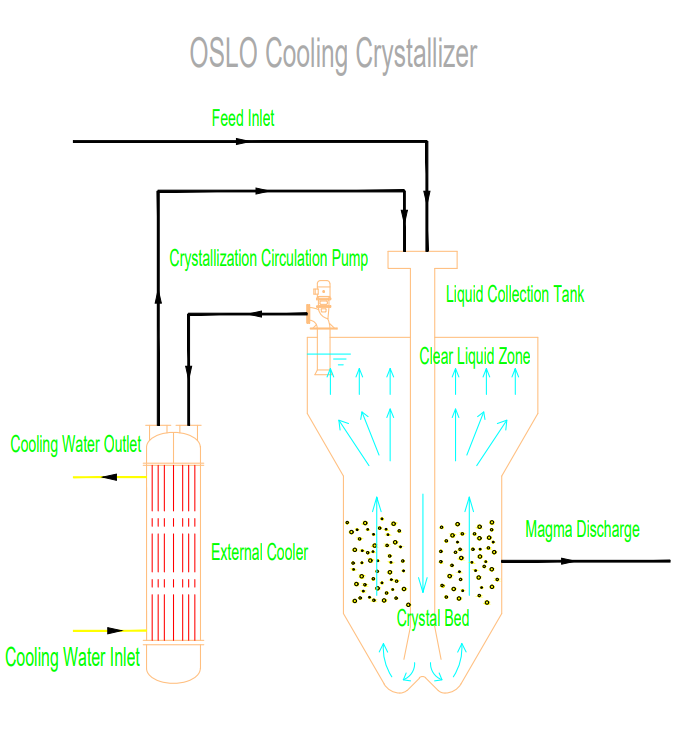
OSLO- Cooled crystallizer | The core is a graded crystallization design for supersaturation generation and crystal growth zones. The supersaturated solution enters from the bottom of the crystal bed and gradually eliminates the supersaturation as it rises slowly, and the crystal grows stably within the crystal bed. The nearly saturated solution overflows from the upper part of the crystallization section, is pumped by the circulating pump to the cooled supersaturated generator (shell and tube heat exchanger), and eventually flows back to the bottom of the crystal bed, forming a strong circulation loop of "overflow → circulating pump → supersaturated generator → bottom of the crystal bed → overflow". The design and operation should strictly control the supersaturation, not exceeding the upper limit of the metastable zone. The clear section above the overflow outlet has a low upward flow rate of the solution, where fine crystals are enriched and removed intermittently or continuously by an external fine crystal trap; The fine crystals are returned to the system after being heated or dissolved in fresh feed solution to eliminate excess fine crystals and ensure steady particle growth. |
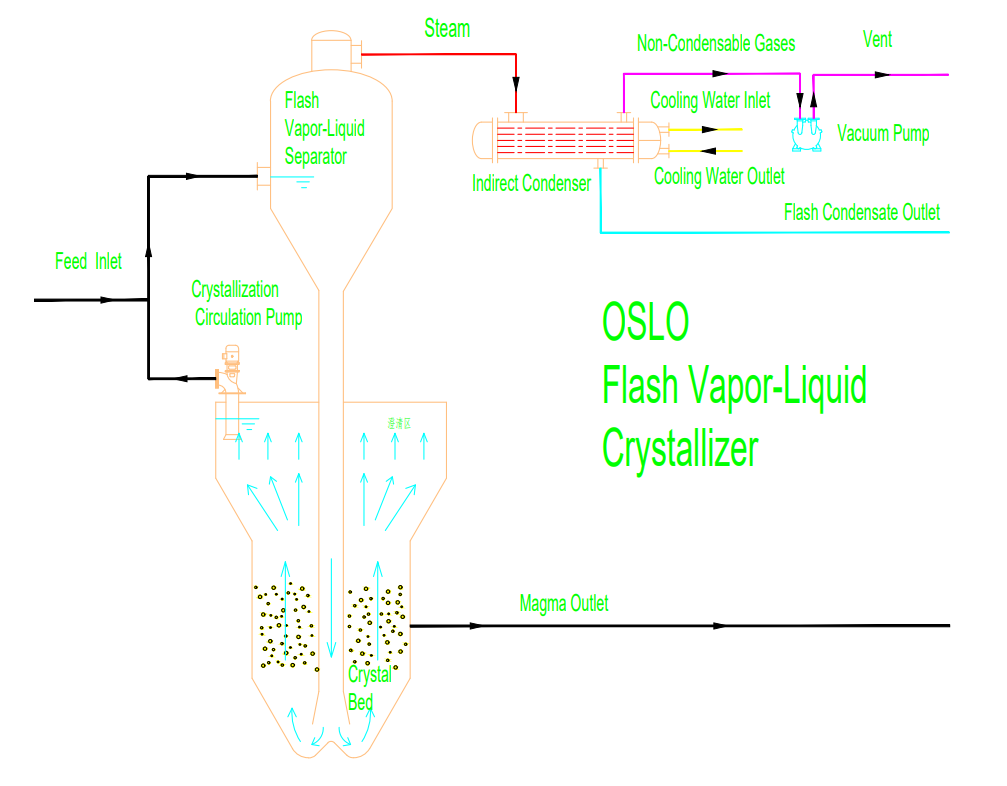
OSLO- Flash (vacuum flash) crystallizer | Following the core logic of OSLO graded crystallization, supersaturation is produced through vacuum adiabatic flash evaporation. The near-saturated solution overflows from the upper part of the crystallization section and is sent into the vacuum flash chamber by the circulating pump. Under high vacuum, part of the solvent vaporizes rapidly, and the solution temperature drops sharply, forming mild supersaturation in the metastable zone. The supersaturated solution enters the bottom of the crystal bed through the central downspout, gradually eliminating the supersaturation as it flows upward, and the crystals grow uniformly within the suspended crystal bed. Fine crystals are also enriched in the upper clarification zone, collected by the fine crystal trap, melted and returned to the system to ensure uniform and coarse main crystal size. |
2. Key technical indicators
Technology Category | OSLO- Cooled crystallizer | OSLO- Flash crystallizer |
Crystal particle size | The particle size can be stably controlled at 1-5 mm, with uniform particles and little entrainment of fine crystals | The particle size can be stably controlled at 0.5-5 mm, and under strict conditions the particle size can reach 1.5-3mm ≥85%, with high roundness |
Particle size distribution | RSD≤15%, with a concentrated particle size distribution; In the case of cobalt sulfate heptahydrate, 1.5-2.5 mm particles account for more than 85% | RSD≤12%, more uniform distribution; In the case of mirage, the proportion of particles 0.8-2 mm can reach over 90% |
Operation mode | Continuous operation, PLC variable frequency control of circulating pump, cooling load, adjustable feeding flow | Full continuous automation operation, PLC linkage control vacuum degree, flash temperature, circulation flow |
Core structure | Crystallization section (crystal bed), cooling heat exchanger, circulating pump, fine crystal trap, cooling water system | Crystallization section (crystal bed), vacuum flash chamber, circulating pump, fine crystal trap, vacuum system + condensation system |
Supersaturation control | Control the temperature difference and flow rate of the cooling heat transfer not exceeding the metastable zone to avoid wall scaling | Control flash vacuum and flash rate, with uniform supersaturation and no local burst nucleation |
Main control parameters | Cooling water temperature difference, circulation flow, liquid level, fine crystal discharge frequency | Flash vacuum degree, flash temperature, circulation flow rate, liquid level, non-condensable gas discharge |
Iii. Material selection and applicability
Material types | Applicable scenarios and descriptions | Adapt to mold type |
Base material SUS304 | Non-corrosive, weakly corrosive material, normal temperature, normal pressure/low vacuum, common inorganic salt crystallization | Cooling type and flash type are compatible |
Corrosion-resistant material SUS316L | Moderately corrosive materials (containing a small amount of acid, alkali, chloride ions), fine chemicals, pharmaceutical scenarios | Cooling type and flash type are applicable |
High corrosion resistance: titanium alloy, Hastelloy | For strong corrosion, high chlorine, high temperature and high vacuum conditions, extend life and reduce leakage risk | Cooling type and flash type universal, flash high vacuum preferred |
Auxiliary material: Q235B | For non-contact material parts such as brackets, enclosures, and thermal shields, reduce costs | Cooling type and flash type are compatible |
4. Applicable materials and processes
Technical categories | OSLO- Cooled Crystallizer | OSLO- Flash crystallizer |
Material requirements | The solubility drops significantly with temperature, the crystal specific gravity is high, the mother liquor viscosity is low, and scaling is not easy | Materials with significant temperature drop solubility, prone to scaling, heat-sensitive, and low boiling point rise |
Typical materials | Sodium sulfate decahydrate (mannitrite), disodium hydrogen phosphate, magnesium sulfate, potassium fluoride, ferrous sulfate, zinc sulfate, cobalt sulfate, copper sulfate, nickel sulfate, sodium thiosulfate, etc. Some organic fine crystalline products | Potassium chloride, ammonium chloride, ammonium sulfate, sodium chloride, urea, potassium dihydrogen phosphate, sodium nitrate, potassium nitrate; Methionine, caprolactam, citric acid, monosodium glutamate, xylitol and other bulk products |
Process fit | Continuous cooling/freezing crystallization, medium to low processing volume, high requirements for particle uniformity and non-scaling scenarios | Continuous vacuum flash crystallization, large tonnage scale production, scaling and heat-sensitive materials can be matched with MVR/ multi-effect evaporation |
5. Comparison table of Core technical advantages
Categories of Strengths | OSLO- Cooled crystallizer | OSLO- Flash crystallizer |
Crystal quality | The fine grains are well controlled, with uniform particle size, high purity and good fluidity | There is no local nucleation on the heat exchange surface, the supersaturation is more uniform, the crystals are rounder and the particle size is more concentrated |
Operational stability | Continuous stable operation, longer cleaning cycle | No scaling or clogging on the heat exchange surface, significantly extended cleaning cycle, and more reliable continuous operation |
Operational controllability | PLC controls cooling, flow, and feeding, with adjustable supersaturation | PLC fully automatic interlocking vacuum, flash evaporation, flow rate, higher control accuracy |
Working condition compatibility | Suitable for cryogenic, medium to low production, and non-scaling materials | Suitable for large processing volumes, scale-prone, heat-sensitive materials, and can be matched with evaporation systems for energy efficiency |
Energy consumption and investment | Low equipment investment, high cooling water consumption | It can recover latent heat, uses less cooling water and has low long-term operating costs; High capacity offers better value for money |
Vi. Supplementary Notes
Both the OSLO cooling and flash crystallizers feature a typical design of supersaturation generation and crystal growth zones, and are mainstream equipment for preparing large-particle, high-uniformity crystals:
The cooling type is more suitable for scenarios with medium and low production capacity, deep cryogenic crystallization, and no obvious tendency to scale.
- Flash evaporation is more suitable for large-tonnage, scale-prone, heat-sensitive materials, and is the preferred solution for inorganic salts, fertilizers, and bulk organic products.
The equipment can be customized in terms of structure, material and automatic control according to the material characteristics, production capacity and operating conditions.
Flow Chart By Type: